What this service covers
An active sub-slab system designed around the foundation in front of it: the deep basements under most Omaha houses, the two-level slabs of Millard split-entries, or the stepped footings of a Gretna walkout. Every install is performed by a specialist licensed under Nebraska's Radiation Control Act working for a licensed radon business, built to the ANSI/AARST SGM-SF-2023 consensus standard, and verified with a retest once the fan has run.
Typical pricing
$1,200-$2,500
Pricing varies by job specifics. Free phone or on-site quotes; fixed pricing once the technician has assessed the job.
What a sub-slab system does under an Omaha basement
Soil gas moves toward low pressure, and in an eastern Nebraska winter the lowest pressure around is the bottom of your heated house. A mitigation system reverses that: a suction pit cored through the slab, sealed piping, and a continuously running fan hold the soil beneath the floor at lower pressure than the basement above it, so the gas rides the pipe past the roofline instead of seeping through the concrete.
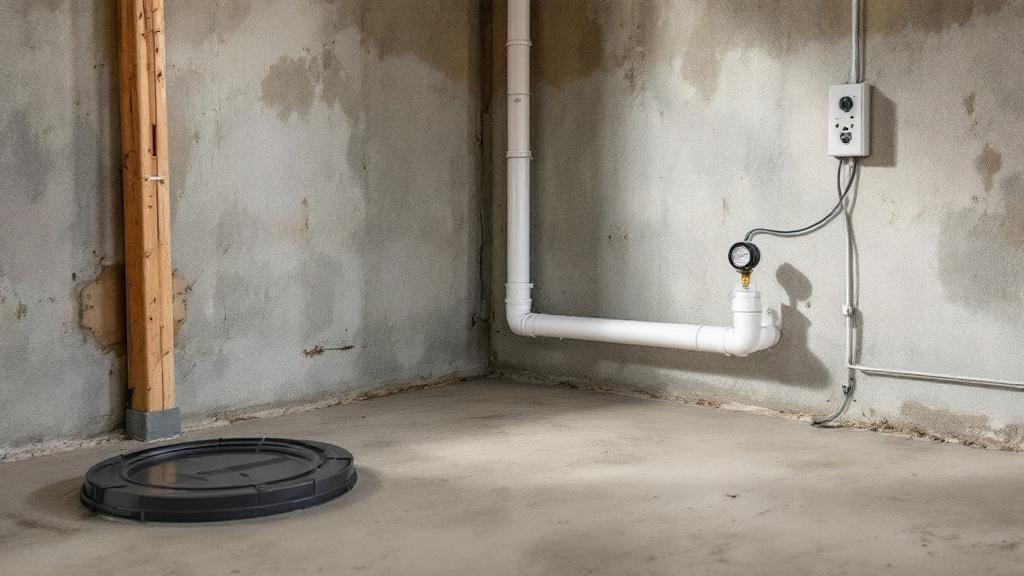
The EPA's Consumer's Guide to Radon Reduction puts active sub-slab suction at a 50 to 99 percent reduction, which is why it is the default fix for the basement foundations that dominate this metro. The fan stays out of the living space, the discharge terminates above the roof, and a manometer on the pipe shows at a glance that suction is holding.
The design work happens before the drill comes out. Omaha sits on loess and glacial till, and what is under a given slab, sand fill, tight clay, or rubble, decides how far one suction point can reach. Diagnostic measurements at a few small test holes tell the specialist whether your floor needs one pit or two, and that finding belongs in the written scope, not in a change order later.
Licensed work under the Radiation Control Act
Nebraska regulates this trade at the state level. Under the Radiation Control Act, Neb. Rev. Stat. 71-3501 and the sections that follow, the person doing the work holds a radon specialist license and the company holds a radon business license from the Department of Health and Human Services, with the program's rules codified at 180 NAC 11. Both licenses are searchable on the state's public lookup, and both expire March 31 of odd-numbered years, so a license that was valid two years ago may not be valid today.
The install itself follows ANSI/AARST SGM-SF-2023, the national consensus standard for existing homes: fan outside the living space, discharge above the roof and away from openings, sealed suction-pit penetrations, a system monitor you can read, and labeling on the pipe. Every system installed through this site is built by a licensed specialist to that standard, and the license numbers are checkable before anyone touches your slab.
Council Bluffs jobs are different paperwork entirely. Iowa certifies radon professionals through Iowa HHS under Iowa Code chapter 136B, and Iowa requires the post-mitigation test to come from a different firm than the installer. A Nebraska license does not cover the Iowa side of the river, and copy on this site never pretends otherwise.
How metro foundations change the design
Basements are close to universal here, but they are not interchangeable. The 1890s-1920s stock in Dundee, Benson, and Field Club sits on limestone-block and early-poured walls with floor drains and patched slabs, which means more sealing work before a fan can hold a pressure field. The huge 1950s-1970s ranch and split-level belt through Millard, Ralston, and La Vista brings sump pits fed by drain tile, plus split-entry homes whose two slab elevations sometimes need two suction points.
Newer Papillion, Gretna, Elkhorn, and Bennington subdivisions pour tighter basements, but many are walkouts stepping down a loess hillside, and stepped footings can cut one end of the floor off from the suction point at the other. Plenty of post-2000 homes also carry a builder rough-in pipe that has never been tested or fanned; activating one is the least expensive system on the price list when the routing checks out.
The numbers justify the attention. Douglas County averaged 4.8 pCi/L across 19,027 pre-mitigation measurements and Sarpy 5.3 across 5,649 in the state's 2019-2024 data, both above the EPA action level of 4.0, and the 1989-1990 state survey found about 54 percent of Nebraska single-family homes over that line.
The paperwork a correct install leaves behind
A fixed written price comes first, after the assessment visit, and it should name the license numbers, the suction-point count, the fan model, the discharge route, and the sealing scope. A quote produced sight-unseen over the phone is a guess, and on a split-level or a walkout it is usually a wrong one.
After the install you keep the system documentation: the start-up manometer reading marked on the gauge, the fan warranty, the labeling on the pipe and the breaker, and the post-install test result showing where the house landed. The EPA's guidance is to retest a mitigated home every two years, so that folder is also your baseline for every future number.
The verification retest is part of the job, not an upsell. A system that cannot show its result on paper is not finished, and when a reading ever drifts, the repair service covers fans, seals, and gauges without redesigning what already works. For the starting range on your foundation type, the cost guide breaks the tiers down.
Service area
Radon Mitigation Systems is available across the Omaha metro and Council Bluffs. Per-suburb pages: